Camry / P0171
A lean-code test case ends with a PCV hose recommendation. The example shows the recommendation, not a completed customer repair.
 Find the cause. Skip the guesswork.
Learn More
A closer look at what the demonstrations show—and what they do not.
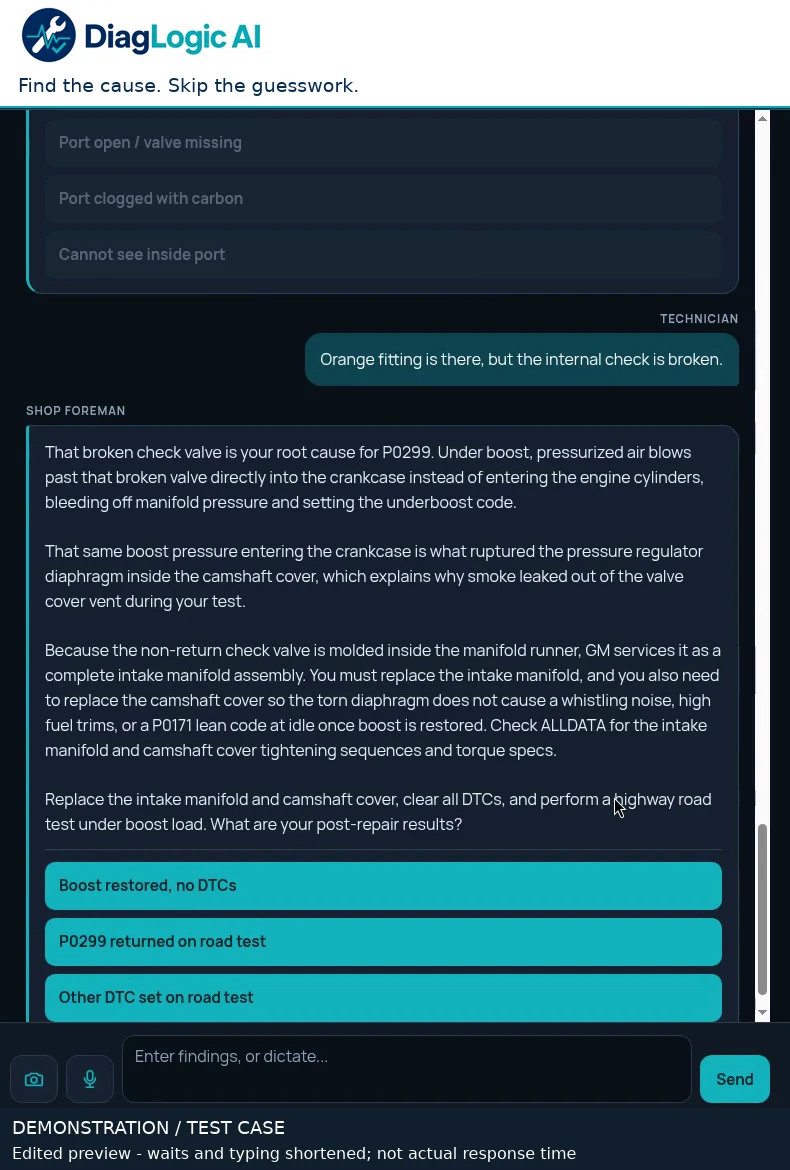
Featured case / 2014 Cruze / P0299
A reported underboost code starts this simulated test case.
The conversation follows checks and reported PCV-system findings.
Replace the intake manifold and camshaft cover, then road test. This is the recommendation shown in the example, not a verified physical repair.
These edited videos show app dialogue, with waits and typing shortened. They are not real-time footage or technical repair instructions. The text beside each video summarizes its case; no playback is needed to understand it.
Explore the other demonstrations
A lean-code test case ends with a PCV hose recommendation. The example shows the recommendation, not a completed customer repair.
A slow-crank test case leads to a ground-connection recommendation and retest. The retest is a next step, not a verified outcome.
A misfire test case leads to an ignition coil recommendation. This edited example does not establish a completed repair.
All four are simulated test cases. No real customer data, measured savings, accuracy rate or guaranteed diagnostic outcome is presented.
Inside the app
Begin with the vehicle, complaint and codes. Vehicle lock helps keep each ticket focused on one vehicle.
A live worksheet tracks tests done, ruled-out causes and the suspected cause as the conversation develops.
The Foreman guides one test at a time and closes with a repair-order style summary. Circuit-testing guidance and TSB and pattern-failure references support the conversation.
DiagLogic AI is not an OEM data source and has no OEM affiliation. Verify service information independently. It is not for SRS/airbags, ADAS calibration, EV high-voltage work, or torque/specification values.
Useful reading
Explore the shop-reported Sierra and RAM cases alongside clearly labeled Cruze and Silverado simulations.
Browse diagnostic guides →No. These examples end at recommendations. Physical repairs and repair outcomes are not verified.
No. Waits and typing are shortened. No accuracy or outcome guarantee is implied.
No. It is an advisory assistant. The technician performs the tests, checks the findings and makes the repair decision.
Use Log in to open the existing app. Google sign-in and email/password are available. Account setup and access checks still happen inside the app.
Start a ticket with the vehicle, complaint and codes, then follow the requested checks one at a time.
Read the Terms and Privacy Policy. The app also presents the agreement at first login.
See the reasoning in the demonstrations. Existing users can continue to their diagnostic workspace.